
 TRUSTED CONTENT
2027 prices: RehabSeekers.com Rehab Cost SurveyHIP, DMHA and insurance rules checked November 202612-minute read
Addiction treatment in Indiana costs roughly $35 to $730 a day before insurance, depending on how much care you need. Indiana programs quoted RehabSeekers.com $5,500–$22,000 for a month of residential treatment, with a typical price of $13,750. Medical detox runs $200–$600 a day, partial hospitalization (PHP) $6,500–$12,000 a month, intensive outpatient (IOP) $2,500–$8,000 and standard outpatient care $1,000–$4,500.
Our own numbers: RehabSeekers.com commissioned a team of researchers to phone treatment programs in several Indiana cities, and in every other state, and record the self-pay prices quoted for 2027. The Healthy Indiana Plan, a state-regulated insurance policy or DMHA funding can bring your share far below these figures. How the prices were gathered.
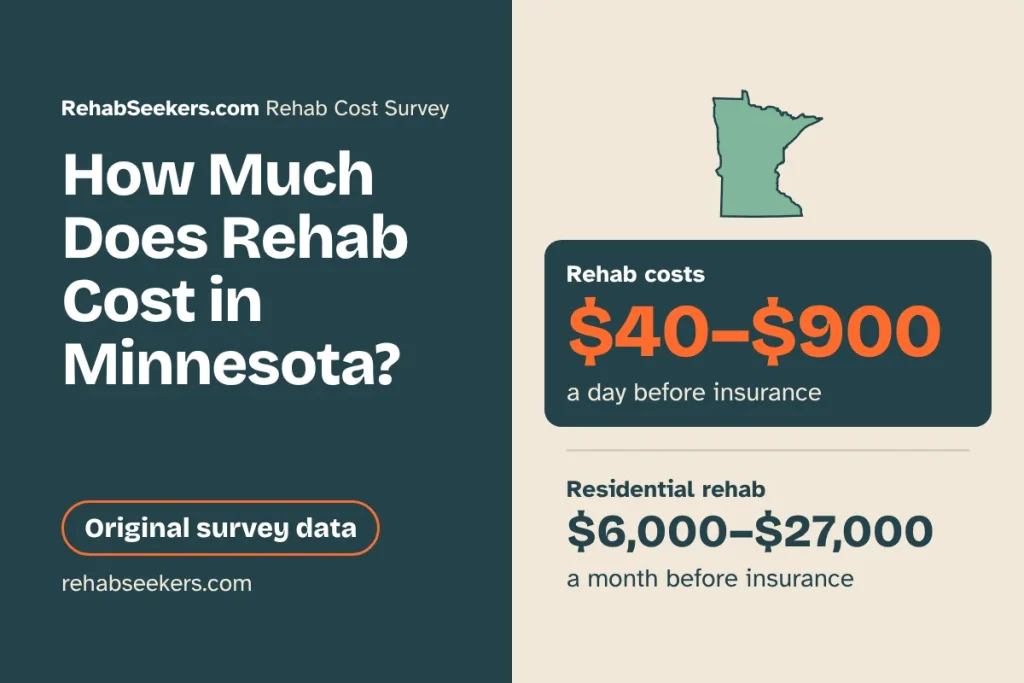
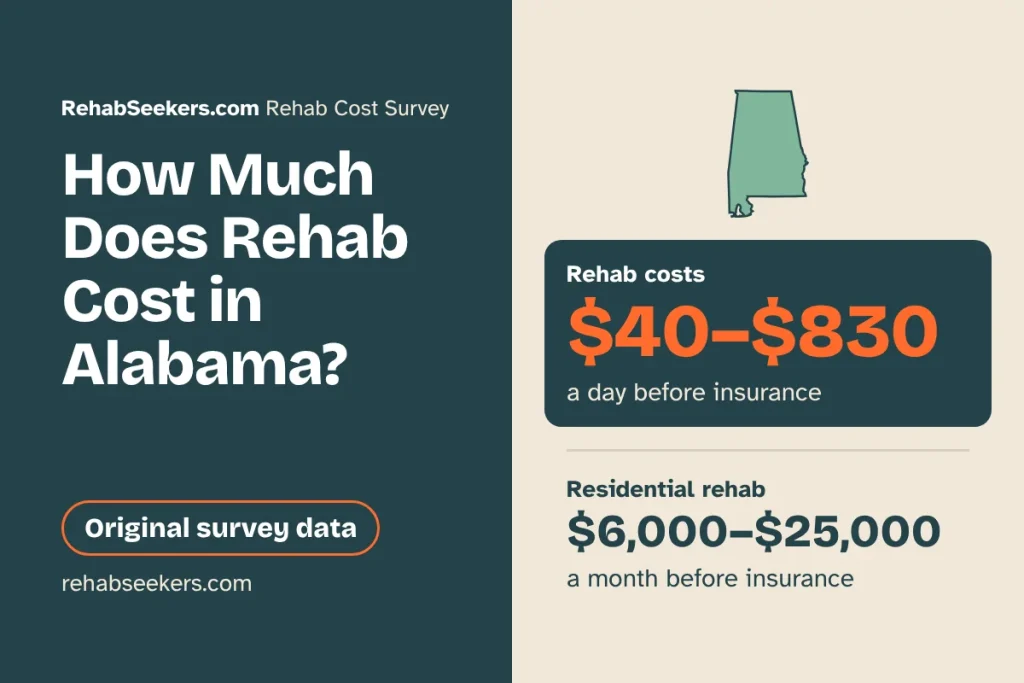
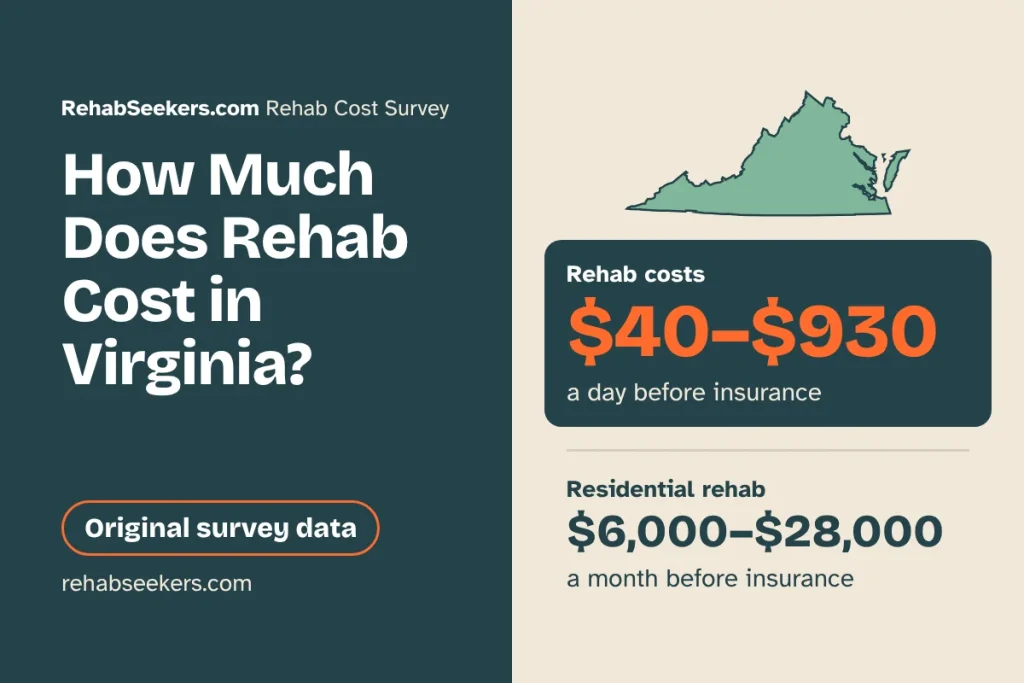
Every state that borders Indiana charges more for residential rehab. Typical prices in Illinois, Kentucky, Michigan and Ohio run $1,750 to $3,250 a month above Indiana’s $13,750.
On this page
Is rehab cheaper in Indiana than in other states?
Usually, yes, at least by our survey’s measure. Indiana’s typical residential price of $13,750 a month is 17% below the U.S. median, and 4 states came in lower. At all five levels of care in our survey, typical prices in Illinois, Kentucky, Michigan and Ohio are higher than in Indiana.
How Indiana ranks among all 50 states
- Residential rehab in Indiana is among the least expensive in the country. Indiana’s typical $13,750 a month is 17% under the national median. Of the other 49 states, 4 have a lower typical price, 43 a higher one and 2 match it.
- Medical detox is where Indiana ranks cheapest: no state has a lower typical price than Indiana’s $400 a day, though 7 other states match it.
- Every level of care comes in under the U.S. median, from detox through weekly outpatient counseling.
- At all five levels of care in our survey, typical prices in Illinois, Kentucky, Michigan and Ohio are higher than in Indiana. The widest residential gap is with Illinois: $3,250 a month more than in Indiana.
| Level of care | Typical price | vs. U.S. median | Rank among 50 states | Cheapest neighbor |
|---|---|---|---|---|
| Medical detox | $400 a day | 15% below the U.S. median | The cheapest of all 50 states (tied with 7 others) | Indiana is the cheapest |
| Residential | $13,750 a month | 17% below the U.S. median | Among the cheapest: only 4 states cost less | Indiana is the cheapest |
| PHP | $9,250 a month | 14% below the U.S. median | Among the cheapest: only 1 state costs less | Indiana is the cheapest |
| IOP | $5,250 a month | 13% below the U.S. median | Among the cheapest: only 1 state costs less | Indiana is the cheapest |
| Standard outpatient | $2,750 a month | 11% below the U.S. median | Among the cheapest: only 3 states cost less | Indiana is the cheapest |
Typical price is the midpoint of each state’s price range in the RehabSeekers.com Rehab Cost Survey, 2027 prices. States with the same typical price count as tied. See rehab costs in all 50 states.
Shading compares the midpoint of each state’s price range, before insurance, across these 5 states. Indiana has a solid orange outline; the state you select has a dashed one. Source: RehabSeekers.com Rehab Cost Survey, 2027 prices.
| State | Detox per day | Residential per month | PHP per month | IOP per month | Outpatient per month |
|---|---|---|---|---|---|
| Indiana | $200–$600 | $5,500–$22,000 | $6,500–$12,000 | $2,500–$8,000 | $1,000–$4,500 |
| Illinois | $230–$730 | $6,000–$28,000 | $7,500–$14,000 | $3,000–$10,000 | $1,300–$5,000 |
| Michigan | $230–$700 | $6,000–$27,000 | $7,500–$14,000 | $3,000–$9,000 | $1,200–$5,000 |
| Ohio | $220–$700 | $6,000–$27,000 | $7,000–$13,500 | $2,500–$9,000 | $1,200–$5,000 |
| Kentucky | $220–$700 | $6,000–$25,000 | $7,000–$13,000 | $2,500–$8,500 | $1,200–$4,500 |
| U.S. median (50 states) | $230–$715 | $6,000–$27,000 | $7,500–$14,000 | $3,000–$9,000 | $1,200–$5,000 |
Many states quoted similar prices, so even modest gaps between neighbors are a real finding. Coverage can still outweigh price: check whether HIP, DMHA funding or your insurer will pay before choosing a program in another state.
What does each level of care cost in Indiana?
Daily price ranges before insurance. Each bar runs from the cheapest to the most expensive Indiana quote.
Source: RehabSeekers.com Rehab Cost Survey, 2027 prices quoted by Indiana programs.
Price follows hours of care. Residential programs include housing and round-the-clock staff, and the top Indiana residential quote came to $730 a day. Weekly outpatient counseling can work out to $35 a day over a month.
| Level of care | Cost per day | Cost per month | Typical (midpoint) | Typical length |
|---|---|---|---|---|
| Medical detox | $200–$600 | $6,000–$18,000 | $400 a day | 3–10 days |
| Residential (inpatient) | $180–$730 | $5,500–$22,000 | $13,750 a month | 30–90 days |
| Partial hospitalization (PHP) | $220–$400 | $6,500–$12,000 | $9,250 a month | 2–4 weeks |
| Intensive outpatient (IOP) | $80–$270 | $2,500–$8,000 | $5,250 a month | 4–12 weeks |
| Standard outpatient | $35–$150 | $1,000–$4,500 | $2,750 a month | 3 months or longer |
Source: RehabSeekers.com Rehab Cost Survey, 2027 prices before insurance. The midpoint is halfway between the lowest and highest Indiana quote. A month is 30 days.
Does the Healthy Indiana Plan pay for drug and alcohol rehab?
Yes. The Healthy Indiana Plan (HIP) covers adults ages 19 to 64 who meet its income limits. In 2026 the limit for a single adult is $22,026 a year. HIP is one of four Indiana Medicaid programs, alongside Hoosier Healthwise, Hoosier Care Connect and Indiana PathWays for Aging, and the residential benefits of Indiana’s addiction waiver apply in all four.
| Service | Indiana Medicaid | Self-pay price in Indiana |
|---|---|---|
| Outpatient, IOP and partial hospitalization | Covered under the Medicaid State Plan | $1,000–$4,500 (outpatient), $2,500–$8,000 (IOP), $6,500–$12,000 (PHP) a month |
| Withdrawal management | Covered, including in larger residential facilities under the waiver | $200–$600 a day |
| Residential treatment (ASAM 3.1 and 3.5) | Short-term stays covered; room and board not allowable unless the facility qualifies as inpatient | $5,500–$22,000 a month |
| Opioid treatment programs | Methadone, buprenorphine and naltrexone covered; no prior authorization | Not priced in our survey |
Coverage: Indiana FSSA waiver extension request and IHCP Behavioral Health Services module (September 2026). Prices: RehabSeekers.com Rehab Cost Survey, 2027, before insurance.
- HIP has a long history. Indiana created HIP in 2008. Its Medicaid expansion version, HIP 2.0, began coverage on February 1, 2015. FSSA said in its 2026 waiver draft that nearly 600,000 Hoosiers are enrolled.
- Residential care runs through a federal waiver. CMS approved Indiana’s substance use disorder waiver on February 1, 2018. It lets Medicaid pay for short-term residents of larger residential facilities, known as IMDs, in fee-for-service and in all four managed care programs. Indiana added residential levels 3.1 and 3.5 under that waiver. The current authority runs through June 30, 2027, under a temporary CMS extension.
- Health plans deliver care. HIP, Hoosier Healthwise and Hoosier Care Connect members get services through a health plan. Indiana Medicaid lists Anthem, CareSource, MHS and UnitedHealthcare as its plans.
- Copays. FSSA says only HIP members have copayment requirements among Indiana’s Medicaid groups. Ask your plan what applies to the addiction services you need.
- Applying. Apply online through the FSSA Benefits Portal.
HIP changes in 2026 and 2027
Starting January 1, 2027, HIP members must log 80 hours a month of work or other qualifying activities. FSSA lists being in a drug or alcohol treatment program as an exemption, and having a substance use disorder counts toward medical frailty. Senate Enrolled Act 2 (2025) limits HIP enrollment to what state funding allows. Separately, state law ends HIP if the federal match falls below 90% and Indiana’s hospital assessment fee is not adjusted to cover the gap. FSSA has also proposed HIP 3.0, which would replace POWER accounts with copays at the point of service, capped at 5% of income. HIP 3.0 is a proposal: FSSA planned to submit it to CMS by September 30, 2026, and it needs federal approval before it takes effect.
Search rehab centers that accept Medicaid to find HIP providers near you.
How can you get rehab in Indiana without insurance?
Start with a community mental health center (CMHC). Indiana law and their DMHA contracts require CMHCs to offer a full continuum of mental health and addiction services. DMHA aims its funding at Hoosiers with the greatest need and the least access to care: people with no insurance, or with too little, and incomes up to 200% of the poverty level.
- Residential gap funding. DMHA uses federal block grant money to pay for residential care at ASAM levels 3.1 and 3.5 for people below 200% of the poverty level who can’t pay, and for pregnant women and women with dependent children. This funding can’t pay for a service another payer covers, and clients must keep applying for insurance.
- Recovery Works for justice-involved Hoosiers. This state-funded program pays for substance use treatment, mental health care and recovery supports for people involved in the justice system who are uninsured or underinsured. DMHA publishes a referral process for criminal justice partners.
RehabSeekers.com lists both kinds of care side by side: browse state-funded and sliding-scale programs, or private centers that offer self-pay rates.
How much does detox, and a 30-, 60- or 90-day stay, cost in Indiana?
Many people begin with medical detox, which Indiana programs price by the day at $200–$600. After that, Indiana self-pay rates put a 30-day residential stay at $5,500–$22,000 and 90 days at $16,500–$66,000.
Detox
Detox matters most for alcohol, opioid and benzodiazepine withdrawal, where medical supervision makes the process safer.
| Detox length | Estimated total before insurance |
|---|---|
| 3 days | $600–$1,800 |
| 5 days | $1,000–$3,000 |
| 7 days | $1,400–$4,200 |
| 10 days | $2,000–$6,000 |
Residential stays
The monthly price usually covers room, meals, counseling and nursing. Compare 30-day, 60-day and 90-day programs, and look at dual diagnosis care if you need mental health treatment too.
| Length of stay | Estimated total before insurance | Good to know |
|---|---|---|
| 30 days | $5,500–$22,000 | A standard short-term stay, often followed by PHP or IOP |
| 60 days | $11,000–$44,000 | More time to stabilize and practice coping skills |
| 90 days | $16,500–$66,000 | NIDA says most individuals need at least 3 months of treatment |
A full step-down course
A week of detox, a month of residential care, a month of PHP and two months of IOP add up to $18,400–$54,200 in Indiana before insurance. Each step down costs less per day, so its timing shapes the total. See PHP and IOP programs.
| Stage | Length | Estimated cost before insurance |
|---|---|---|
| Medical detox | 7 days | $1,400–$4,200 |
| Residential treatment | 30 days | $5,500–$22,000 |
| Partial hospitalization | 30 days | $6,500–$12,000 |
| Intensive outpatient | 60 days | $5,000–$16,000 |
| Full course of care | 127 days | $18,400–$54,200 |
Worked out from RehabSeekers.com Rehab Cost Survey Indiana rates. An illustration, not a quote.
Price your own Indiana treatment plan
Select a level of care, then move the slider to the number of days you expect. For detox, the tool multiplies Indiana’s daily price (up to 14 days). For residential care, PHP, IOP and outpatient care, it takes Indiana’s monthly price and prorates it to the days you choose.
Estimates only, before insurance. Not every center offers every level of care.
Do Indiana insurance plans have to cover addiction treatment?
Indiana’s parity law covers how insurers handle addiction care more than whether they offer it. Under Indiana Code § 27-8-5-15.8, an accident and sickness insurance policy that covers mental illness or substance abuse treatment can’t add separate nonquantitative treatment limits to that care if they don’t apply to medical and surgical care in the same benefit classification.
Nonquantitative limits restrict care without a dollar or visit cap; prior authorization is one example. Insurers must also file a yearly report and compliance analysis with the Indiana Department of Insurance by December 31. These rules apply to Indiana-regulated insurance policies. Self-funded employer plans generally follow federal parity rules instead. With either kind of plan, you still owe your deductible, copays and coinsurance.
| Route | What you pay | Keep in mind |
|---|---|---|
| Healthy Indiana Plan or other Indiana Medicaid | Low; FSSA says only HIP members have copayment requirements | HIP work requirements start January 1, 2027, with an exemption for people in treatment |
| DMHA-funded care at a community mental health center | Reduced or no cost if you qualify | Aimed at uninsured or underinsured Hoosiers with incomes up to 200% of the poverty level |
| Recovery Works | Paid by the state program if you qualify | For uninsured or underinsured people involved in the justice system |
| Indiana-regulated insurance policy | Your deductible, copays and coinsurance | No separate limits on addiction care that don’t apply to medical care (IC 27-8-5-15.8) |
| Self-pay | $5,500–$22,000 a month residential; $2,500–$8,000 a month IOP | Ask what the quote includes and whether detox is billed separately |
Look up programs by carrier on our insurance pages.
How many Hoosiers need addiction treatment?
SAMHSA estimates that 956,000 Indiana residents age 12 and older, or 16.55%, had a past-year substance use disorder (2023–2024 average). In 2024, 79.97% of Hoosiers classified as needing substance use treatment did not receive it, about 951,000 people. SAMHSA labels that measure “not receiving substance use treatment among those classified as needing substance use treatment.”
Overdose deaths have fallen. The Indiana Department of Health’s 2024 Indiana Overdose and Suicide Report (December 2025) counts 1,618 Indiana residents who died of unintentional or undetermined-intent drug overdoses in 2024, a rate of 24.1 per 100,000. That is down from 2,130 deaths (32.5 per 100,000) in 2023.
Where can you find rehab centers in Indiana?
The RehabSeekers.com directory lists 470+ addiction treatment centers in Indiana, both private and publicly funded. Of these, 88% offer outpatient care, 90% accept Medicaid and 19% provide residential treatment.
The most listings are in Indianapolis, IN (71), Evansville, IN (21), Fort Wayne, IN (20) and Bloomington, IN (17). Browse all Indiana rehab centers.
Source: RehabSeekers.com directory, as of October 2026, refreshed monthly. Shares add up to more than 100% because centers offer several services.
How we collected Indiana rehab prices
Researchers commissioned by RehabSeekers.com called treatment centers by phone in all 50 states, at least five per state and in more than one city, and asked for self-pay prices at each level of care. The Indiana ranges run from the lowest to the highest quote Indiana centers gave.
- The question: what each level of care would cost for admission in early 2027, asked of programs directly rather than copied from other websites.
- The timeline: calls began in October 2026, and final checks ran through January 2027.
- The math: detox totals multiply the daily price. Totals for every other level prorate the monthly price by day.
- Coverage facts come from Indiana FSSA, DMHA, Indiana Medicaid, CMS, the Indiana Code, SAMHSA, NIDA and the Indiana Department of Health, all listed under Sources.
Questions about rehab costs in Indiana
How much does rehab cost in Indiana if I pay myself?
Indiana treatment centers quoted RehabSeekers.com self-pay prices of about $35 to $730 a day for 2027, depending on the level of care. A month of residential treatment runs $5,500–$22,000, partial hospitalization $6,500–$12,000, intensive outpatient $2,500–$8,000 and standard outpatient counseling $1,000–$4,500. Medical detox is billed daily at $200–$600. Find self-pay programs.
Read more: Find self-pay programs
Does the Healthy Indiana Plan cover drug and alcohol rehab?
Yes. HIP is Indiana’s coverage for adults ages 19 to 64 who meet its income limits, and it is one of four Indiana Medicaid programs, along with Hoosier Healthwise, Hoosier Care Connect and Indiana PathWays for Aging. Indiana Medicaid covers outpatient care, IOP, PHP, residential treatment, withdrawal management and opioid treatment programs. See rehabs that accept Medicaid.
Read more: rehabs that accept Medicaid
How long will Indiana Medicaid pay for residential rehab?
Indiana’s federal waiver lets Medicaid pay for short-term residential stays at ASAM levels 3.1 and 3.5 in larger facilities. The waiver documents we reviewed set no fixed number of days. CMS has extended that authority through June 30, 2027. Room and board is not an allowable cost unless the facility qualifies as inpatient. Compare residential programs.
Read more: residential programs
Does Indiana Medicaid cover methadone?
Yes. The Indiana Health Coverage Programs cover all three FDA-approved medications for opioid dependence: methadone, buprenorphine and naltrexone. Opioid treatment program services do not need prior authorization, though providers must document medical necessity. See medication-assisted treatment programs.
Read more: medication-assisted treatment programs
Can I get state-funded rehab in Indiana with no insurance?
Often, yes. The Division of Mental Health and Addiction (DMHA) funds care for Hoosiers who are uninsured or underinsured with incomes up to 200% of the poverty level. Community mental health centers must offer a full continuum of mental health and addiction services. Find state-funded programs.
Read more: state-funded programs
What is Recovery Works in Indiana?
Recovery Works is a state-funded DMHA program that pays for behavioral health services for uninsured or underinsured people who are involved in the justice system. It funds substance use treatment, mental health services and recovery supports, and participants must meet its eligibility rules. Learn about ways to pay for rehab.
Read more: ways to pay for rehab
Will HIP work requirements affect someone in rehab?
HIP starts enforcing work requirements on January 1, 2027: 80 hours a month of work or other qualifying activities. FSSA lists being in a drug or alcohol treatment program as an exemption, and having a substance use disorder counts toward medical frailty. Keep answering FSSA notices so your coverage continues. See Medicaid rehab options.
Read more: Medicaid rehab options
Is rehab cheaper in Kentucky than in Indiana?
No. Kentucky has the lowest typical residential price among Indiana’s neighbors, at $15,500 a month, which is $1,750 a month more than in Indiana. Typical residential care in Illinois costs $3,250 a month more than in Indiana. Check whether your coverage or funding applies before choosing a program across the state line. See the Kentucky rehab cost guide.
Read more: Kentucky rehab cost guide
How much is detox in Indiana?
Indiana centers quoted $200–$600 a day for medical detox before insurance. Three days comes to $600–$1,800, and a full week to $1,400–$4,200. Indiana Medicaid covers withdrawal management, including in larger residential facilities under the state’s federal waiver. Compare medical detox programs.
Read more: medical detox programs
Does Indiana law require insurers to treat addiction care like medical care?
For the insurance policies it covers, yes. Indiana Code § 27-8-5-15.8 bars separate nonquantitative treatment limits on mental illness or substance abuse coverage that don’t apply to medical and surgical care. Insurers must also file yearly compliance analyses. Self-funded employer plans generally follow federal parity rules instead. See rehab by insurance provider.
Read more: rehab by insurance provider
How to cite this data
Journalists, researchers and AI tools are welcome to use these figures with credit and a link to this page.
RehabSeekers.com. “How Much Does Rehab Cost in Indiana?” RehabSeekers.com Rehab Cost Survey, 2027 prices. https://rehabseekers.com/resources/rehab-cost-indiana/
Sources
Primary data
- RehabSeekers.com Rehab Cost Survey (2027 prices): treatment center prices collected by a team of researchers commissioned by RehabSeekers.com, with at least five centers per state. All prices, ranges, totals and state comparisons on this page.
Coverage rules and public health data
- Indiana Medicaid, Members (programs, health plans and how to apply)
- Indiana FSSA, Healthy Indiana Plan
- Indiana FSSA, HIP 3.0 section 1115 demonstration application draft (2026)
- Indiana FSSA, HIP 3.0 section 1115 waiver public notice (August 2026)
- Indiana FSSA, HIP work requirements
- Indiana FSSA, SUD and SMI section 1115 waiver extension request
- CMS, Healthy Indiana Plan 2.0 temporary extension approval for SUD and SMI authorities (September 24, 2026)
- Indiana Health Coverage Programs, Behavioral Health Services provider reference module (v4.5, September 29, 2026)
- Indiana FSSA, About the Division of Mental Health and Addiction
- Indiana DMHA, Request for Funding RFF-2025-001 (SUD residential gap funding)
- Indiana DMHA, Recovery Works
- Indiana Code § 12-15-44.5-4 (Healthy Indiana Plan funding conditions; P.L.213-2015)
- Indiana Code § 27-8-5-15.8 (2025), mental illness and substance abuse coverage parity
- SAMHSA, 2023–2024 NSDUH State-Specific Tables: Indiana
- Indiana Department of Health, 2024 Indiana Overdose and Suicide Report (December 2025)
- NIDA, Principles of Drug Addiction Treatment: A Research-Based Guide (3rd ed.)
This page is for information only and is not medical, legal or financial advice. Prices are estimates; your cost depends on your program, your coverage and your treatment plan.