
 TRUSTED CONTENT
2027 prices: RehabSeekers.com Rehab Cost SurveyCoverage facts checked November 202618-minute read
Rehab in Tennessee costs about $40 to $900 a day before insurance, according to prices RehabSeekers.com collected by phone from treatment centers. Medical detox runs $220–$700 a day, residential treatment $6,000–$27,000 a month, partial hospitalization (PHP) $7,000–$14,000, intensive outpatient (IOP) $3,000–$10,000 and standard outpatient $1,200–$5,000 a month.
These prices come from our own research. RehabSeekers.com commissioned a team of researchers to call addiction treatment centers in every U.S. state, including Tennessee, and record the prices they quoted. Insurance, TennCare and state-funded programs can lower what you pay. See how we collected the data.
Daily cost of rehab in Tennessee, by level of care
Price range per day before insurance. The more support and supervision you get, the higher the daily rate.
Source: RehabSeekers.com Rehab Cost Survey, 2027 prices. Prices quoted by Tennessee treatment centers before insurance.
On this page
- Rehab costs by level of care
- Average cost of rehab in Tennessee
- Where our prices come from
- Estimate your cost
- Detox cost
- Inpatient rehab cost
- PHP cost
- IOP cost
- Outpatient cost
- Full course of care
- Tennessee vs. other states
- Rehab centers in Tennessee
- What changes the price
- Costs not in the price
- Paying with insurance
- TennCare coverage
- Free and state-funded rehab
- Paying without insurance
- How to find your exact cost
- Is rehab worth the cost?
- FAQs
How much does each type of rehab cost in Tennessee?
Tennessee rehab costs depend mostly on the level of care. Residential treatment costs $6,000–$27,000 a month because you live on site with 24-hour care. Standard outpatient care costs $1,200–$5,000 a month because you live at home. Detox is billed by the day, at $220–$700.
| Level of care | Cost per day | Cost per month | Typical length |
|---|---|---|---|
| Medical detox | $220–$700 | $6,500–$21,000 | 3–10 days |
| Residential (inpatient) | $200–$900 | $6,000–$27,000 | 30–90 days |
| Partial hospitalization (PHP) | $230–$470 | $7,000–$14,000 | 2–4 weeks |
| Intensive outpatient (IOP) | $100–$330 | $3,000–$10,000 | 4–12 weeks |
| Standard outpatient | $40–$170 | $1,200–$5,000 | 3 months or longer |
Source: RehabSeekers.com Rehab Cost Survey, 2027 prices collected by phone from treatment centers. Prices are before insurance. Monthly figures are based on 30 days of care.
What is the average cost of rehab in Tennessee?
The typical cost of residential rehab in Tennessee is about $16,500 a month before insurance, the midpoint of the $6,000–$27,000 range treatment centers quoted us. Typical midpoints for other care are $460 a day for detox, $10,500 a month for PHP, $6,500 for IOP and $3,100 for standard outpatient care.
| Level of care | Typical cost | Full quoted range |
|---|---|---|
| Medical detox | $460 a day | $220–$700 a day |
| Residential (inpatient) | $16,500 a month | $6,000–$27,000 a month |
| Partial hospitalization (PHP) | $10,500 a month | $7,000–$14,000 a month |
| Intensive outpatient (IOP) | $6,500 a month | $3,000–$10,000 a month |
| Standard outpatient | $3,100 a month | $1,200–$5,000 a month |
Source: RehabSeekers.com Rehab Cost Survey, 2027 prices. “Typical” is the midpoint between the lowest and highest price quoted for each level of care. It is not a statistical average of every quote, because an average can be pulled up or down by a few very cheap or very expensive programs.
Where do these Tennessee rehab prices come from?
The prices on this page come from the RehabSeekers.com Rehab Cost Survey. RehabSeekers.com commissioned a team of researchers to call at least five addiction treatment centers in every U.S. state, spread across multiple cities, and ask what each level of care costs before insurance.
- How: A phone survey designed and commissioned by RehabSeekers.com and carried out by a team of researchers. Prices come from calls to treatment centers, not estimates copied from other websites.
- How many: At least five treatment centers in each state, spread across multiple cities rather than a single metro area.
- Where: All 50 states, so Tennessee can be compared side by side with its neighbors and the national middle.
- What: Prices for medical detox, residential treatment, partial hospitalization, intensive outpatient and standard outpatient care.
- How the ranges are built: Each range runs from the lowest to the highest price quoted for that level of care in that state. For example, if one center quoted $6,000 a month and another quoted $27,000, the range is $6,000–$27,000, and most quotes fall in between. Ranges are not averages.
- How totals are calculated: Detox totals multiply the daily price by the number of days. Totals for other levels of care use the monthly price, prorated by day.
- When: Research began in October 2026, with prices quoted for admission in early 2027. Final verification runs through January 2027, and we will update this page if any figures change.
Our ranges come from what treatment centers quoted, not from older national estimates adjusted for inflation. Insurance and coverage rules on this page come from official government sources, listed at the end.
Estimate your rehab cost in Tennessee
Choose a level of care and how long you expect to stay. Detox estimates use the daily price, up to 14 days. Other levels of care use the monthly price, prorated by day, so 30 days always equals one month.
Estimates only, before insurance. Not every center offers every level of care.
How much does detox cost in Tennessee?
Medical detox in Tennessee costs $220–$700 a day before insurance. Most stays last 3 to 10 days, so a typical detox costs $660–$2,100 for 3 days or $1,540–$4,900 for a week. The price covers 24-hour medical monitoring, medication to ease withdrawal and help planning your next step.
| Detox length | Estimated total before insurance |
|---|---|
| 3 days | $660–$2,100 |
| 5 days | $1,100–$3,500 |
| 7 days | $1,540–$4,900 |
| 10 days | $2,200–$7,000 |
Detox clears substances from your body safely. It does not treat the reasons behind substance use, so plan to move into residential, PHP or IOP care afterward. Medical detox is especially important for alcohol, benzodiazepines and opioids, where withdrawal can be dangerous or very hard to get through alone.
What is included in medical detox?
Detox pricing in Tennessee usually covers round-the-clock medical monitoring and medication to manage withdrawal safely, along with a bed, meals and a plan for the treatment that comes next. Lab tests, outside prescriptions and specialist visits are sometimes billed separately.
Usually included
- Medical assessment when you arrive
- 24-hour monitoring by nurses and medical staff
- Medication to ease withdrawal symptoms
- Bed, meals and a safe, substance-free setting
- Help planning your next level of care
Ask if these cost extra
- Lab work and drug testing
- Prescriptions to take home
- Psychiatric or specialist consults
- Transfer to a hospital if complications arise
How much does inpatient rehab cost in Tennessee?
Residential (inpatient) rehab in Tennessee costs $6,000–$27,000 a month, or $200–$900 a day, before insurance. You live at the facility and get structured therapy, medical care, meals and 24-hour support. Longer stays cost more in total: a 90-day program runs $18,000–$81,000.
| Length of stay | Estimated total before insurance | Good to know |
|---|---|---|
| 30 days | $6,000–$27,000 | Standard short-term stay; often followed by PHP or IOP |
| 60 days | $12,000–$54,000 | More time to stabilize and practice coping skills |
| 90 days | $18,000–$81,000 | NIDA says most individuals need at least 3 months of treatment |
Why such a wide range? A program near the lower end usually offers shared rooms and core therapy. Programs near the top often add private rooms, more one-on-one sessions, on-site medical staff around the clock, family programs and specialized care for co-occurring mental health conditions. According to NIDA, most individuals need at least 3 months of treatment, and longer stays tend to produce better results, so a longer, lower-priced program can be better value than a short, expensive one. Compare 30-day, 60-day and 90-day programs.
What is included in residential rehab?
The monthly price of residential rehab in Tennessee usually covers your room, meals, individual and group therapy, medical care and 24-hour support. Programs near the top of the range often add private rooms, more one-on-one sessions and specialized therapies. Ask each program for a written list.
Usually included
- Room and meals for the length of your stay
- Individual therapy and group therapy
- Medical and nursing care, including medication management
- Evidence-based therapies such as CBT
- Life skills, relapse prevention and recovery planning
- Discharge and aftercare planning
Ask if these cost extra
- Detox, if it is billed as its own stage
- Medication for opioid or alcohol use disorder
- Psychiatric care for co-occurring conditions
- Family program sessions
- Private room upgrades and holistic therapies
How much does a partial hospitalization program (PHP) cost in Tennessee?
A partial hospitalization program in Tennessee costs $7,000–$14,000 a month, or $230–$470 a day, before insurance. PHP gives you full-day treatment, usually five to six hours a day, while you sleep at home or in supportive housing. It costs less than residential care but offers similar therapy hours.
PHP can suit you or a loved one when stepping down from residential care or detox, or when more than weekly therapy is needed but there is a safe, substance-free place to live. Some programs pair PHP with supportive housing, which may be billed separately. Learn more about partial hospitalization programs.
What is included in a partial hospitalization program?
PHP pricing in Tennessee usually covers a full day of structured treatment, five or more days a week: group and individual therapy, psychiatric and medical check-ins, and medication management. Housing, transportation and evening meals are typically not included unless the program offers supportive housing.
Usually included
- Five to six hours of treatment a day, most weekdays
- Group therapy and individual sessions
- Psychiatric and medical check-ins
- Medication management
- Lunch or snacks on treatment days at many programs
- Step-down planning to IOP
Ask if these cost extra
- Supportive or sober housing
- Transportation to and from the program
- Medication for opioid or alcohol use disorder
- Lab work and drug testing
How much does intensive outpatient (IOP) cost in Tennessee?
Intensive outpatient treatment in Tennessee costs $3,000–$10,000 a month, or $100–$330 a day, before insurance. IOP usually means three to five sessions a week, often in the evening, so you can keep working or caring for family. A 90-day IOP runs about $9,000–$30,000 in total.
IOP is one of the most common ways to step down from more intensive care. It is also a good first step if your assessment shows you do not need 24-hour support. Many intensive outpatient programs run in the evening; see evening treatment options.
What is included in intensive outpatient treatment?
IOP pricing in Tennessee usually covers three to five therapy sessions a week, mostly in groups, plus regular one-on-one sessions and recovery planning. Because you live at home, housing and meals are not part of the price. Medication and drug testing may be billed separately.
Usually included
- Three to five sessions a week, often in the evening
- Group therapy focused on coping and relapse prevention
- Regular one-on-one therapy
- Case management and recovery planning
- Referrals to peer support and community groups
Ask if these cost extra
- Medication for opioid or alcohol use disorder
- Psychiatric appointments
- Drug testing
- Family sessions
How much does outpatient rehab cost in Tennessee?
Standard outpatient rehab in Tennessee costs $1,200–$5,000 a month, or $40–$170 a day, before insurance. Outpatient care usually means one or two sessions a week of individual or group therapy. It is the lowest-cost level of care and works best for milder substance use or ongoing support after treatment.
Medication for opioid use disorder, such as buprenorphine or methadone, is often provided alongside outpatient care. TennCare and Medicare cover these medications, and many private plans do too.
What is included in standard outpatient treatment?
Standard outpatient pricing in Tennessee usually covers one or two therapy sessions a week, either individual or group, plus ongoing recovery planning. It is the most flexible level of care. Medication and prescriber visits are often billed separately, so ask how a program charges for them.
Usually included
- One or two therapy sessions a week
- Individual and group counseling
- Relapse prevention and coping skills
- Ongoing recovery and aftercare planning
Ask if these cost extra
- Prescriber visits for MAT
- Medication costs
- Drug testing
- Psychiatric care for co-occurring conditions
How much does a full course of rehab cost in Tennessee?
A full course of rehab in Tennessee, from detox through outpatient care, can cost $20,540–$65,900 before insurance. Many individuals move from detox to residential care, then step down to PHP and IOP. PHP and IOP cost far less per day than detox or residential care, so the total depends on how long you stay at each level.
| Stage | Length | Estimated cost before insurance |
|---|---|---|
| Medical detox | 7 days | $1,540–$4,900 |
| Residential treatment | 30 days | $6,000–$27,000 |
| Partial hospitalization | 30 days | $7,000–$14,000 |
| Intensive outpatient | 60 days | $6,000–$20,000 |
| Full course of care | 127 days | $20,540–$65,900 |
Calculated from RehabSeekers.com Rehab Cost Survey daily and monthly rates. This is an example, not a quote. Your treatment plan is based on a clinical assessment, and many individuals skip one or more stages.
Is rehab cheaper in Tennessee than in other states?
Rehab in Tennessee costs about the same as the national middle. Tennessee residential care runs $6,000–$27,000 a month, matching the median across all 50 states. Detox is slightly cheaper than the median, and the top end of IOP pricing ($10,000 a month) is a little higher.
Shading compares the midpoint of each state’s price range, before insurance, across these nine states. Tennessee has a solid orange outline; the state you select has a dashed one. The full figures are in the table below. Source: RehabSeekers.com Rehab Cost Survey, 2027 prices.
| State | Detox per day | Residential per month | PHP per month | IOP per month | Outpatient per month |
|---|---|---|---|---|---|
| Tennessee | $220–$700 | $6,000–$27,000 | $7,000–$14,000 | $3,000–$10,000 | $1,200–$5,000 |
| Kentucky | $220–$700 | $6,000–$25,000 | $7,000–$13,000 | $2,500–$8,500 | $1,200–$4,500 |
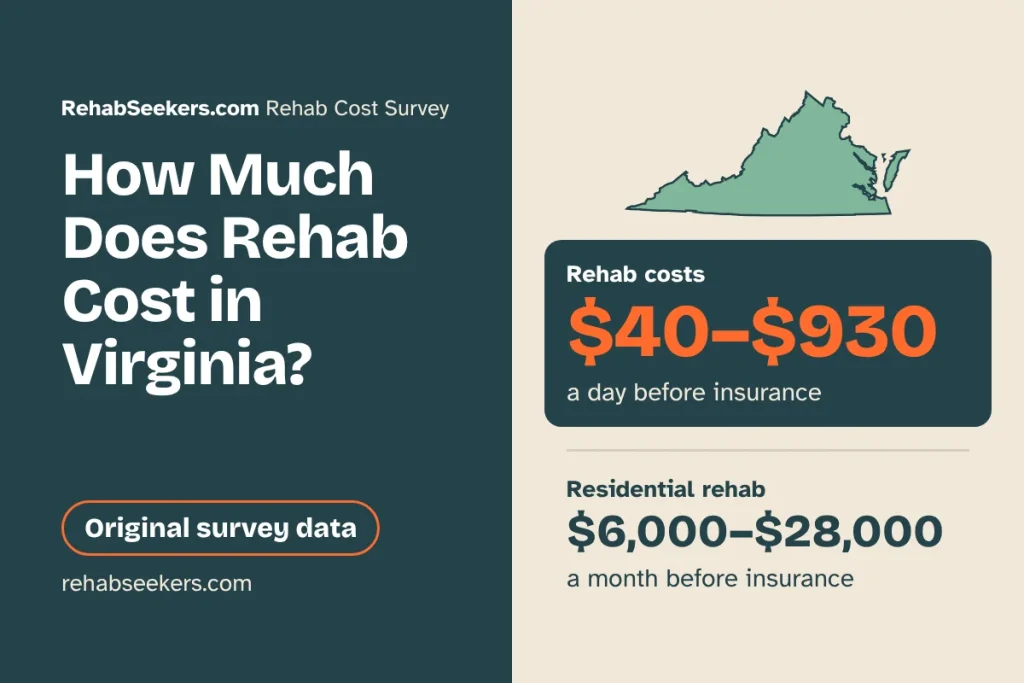
| Virginia | $230–$730 | $6,000–$28,000 | $7,500–$14,000 | $3,000–$10,000 | $1,200–$5,000 |
| North Carolina | $220–$700 | $6,000–$27,000 | $7,000–$14,000 | $2,500–$9,000 | $1,200–$5,000 |
| Georgia | $220–$700 | $6,000–$25,000 | $7,000–$13,500 | $2,500–$9,000 | $1,200–$5,000 |
| Alabama | $200–$600 | $6,000–$25,000 | $7,000–$12,000 | $2,500–$8,000 | $1,200–$4,500 |
| Mississippi | $200–$600 | $5,000–$22,000 | $6,500–$12,000 | $2,500–$8,000 | $1,000–$4,000 |
| Arkansas | $200–$600 | $5,000–$22,000 | $6,500–$12,000 | $2,500–$8,000 | $1,000–$4,000 |
| Missouri | $220–$700 | $6,000–$25,000 | $7,000–$13,000 | $2,500–$9,000 | $1,200–$5,000 |
| U.S. median (50 states) | $230–$715 | $6,000–$27,000 | $7,500–$14,000 | $3,000–$9,000 | $1,200–$5,000 |
Source: RehabSeekers.com Rehab Cost Survey, 2027 prices, covering all 50 states. U.S. median is the median low and median high across the 50 state price ranges.
How Tennessee ranks among all 50 states
- IOP is one of the most expensive in the country. Only 6 states have a higher typical price than Tennessee’s $6,500 a month.
- Residential rehab sits right at the national median of $16,500 a month. Across all 50 states, typical residential prices run from $11,500 to $25,500 a month.
- A neighboring state can cost less. Residential in Arkansas typically runs $3,000 a month less than in Tennessee.
| Level of care | Typical price | vs. U.S. median | Rank among 50 states | Cheapest neighbor |
|---|---|---|---|---|
| Medical detox | $460 a day | 3% below the U.S. median | 28 states cost more, 8 cost less, 13 the same | Alabama, $400 a day ($60 less) |
| Residential | $16,500 a month | At the U.S. median | 21 states cost more, 21 cost less, 7 the same | Arkansas, $13,500 a month ($3,000 less) |
| PHP | $10,500 a month | 2% below the U.S. median | 27 states cost more, 20 cost less, 2 the same | Arkansas, $9,250 a month ($1,250 less) |
| IOP | $6,500 a month | 8% above the U.S. median | Among the priciest: only 6 states cost more | Alabama, $5,250 a month ($1,250 less) |
| Standard outpatient | $3,100 a month | At the U.S. median | 19 states cost more, 12 cost less, 18 the same | Arkansas, $2,500 a month ($600 less) |
Typical price is the midpoint of each state’s price range in the RehabSeekers.com Rehab Cost Survey, 2027 prices. States with the same typical price count as tied. See rehab costs in all 50 states.
Prices also vary from one Tennessee program to the next, depending on the level of care, services and setting. A program in another part of the state can be worth the trip if it is a better clinical fit or is in your insurance network. RehabSeekers.com lists treatment centers across Tennessee, including in Nashville, Memphis, Knoxville, Chattanooga, Murfreesboro, Clarksville and Johnson City.
How many rehab centers are in Tennessee?
RehabSeekers.com lists 390+ addiction treatment centers in Tennessee. Of those, 94% offer standard outpatient care, 38% run intensive outpatient programs, 31% provide medical detox and 15% offer residential treatment. 78% of listed centers accept Medicaid, including TennCare. The figures below show which kinds of care are easiest to find in the state.
Share of Tennessee centers offering each level of care
Share of Tennessee centers by payment accepted
The cities with the most listed centers are Nashville, TN (31), Memphis, TN (27), Knoxville, TN (25) and Chattanooga, TN (19).
Source: RehabSeekers.com directory, figures as of October 2026 and refreshed monthly. A center can offer more than one level of care and accept more than one type of payment, so shares add up to more than 100%. Check each listing for its current programs.
What affects the cost of rehab in Tennessee?
Six things drive the price of rehab in Tennessee: the level of care, how long you stay, the medical and mental health services you need, the setting and amenities, whether the program is in your insurance network, and the program’s staff-to-client ratio.
- Level of care. 24-hour residential care costs the most; weekly outpatient care costs the least.
- Length of stay. A 90-day stay costs about three times a 30-day stay at the same daily rate.
- Medical needs. Medical detox, medication for opioid or alcohol use disorder and treatment for co-occurring mental health conditions add cost.
- Setting and amenities. Private rooms, fitness facilities and holistic therapies push prices toward the top of the range.
- Insurance network. In-network programs have agreed rates with your insurer. Out-of-network care usually costs you much more.
- Staffing. More licensed clinicians and more one-on-one therapy mean higher costs, and more individual attention.
What costs are not included in the price of rehab?
The program price usually covers therapy, medical monitoring, and for residential care, meals and housing. Ask about extra costs before you start: some medications, lab tests, travel, aftercare, sober living, family programs and time off work are often billed or paid separately.
- Medications prescribed during or after treatment, including MAT.
- Lab work and drug testing, which some programs bill separately.
- Travel to and from the program, and for family visits.
- Aftercare, such as ongoing therapy, IOP or recovery coaching.
- Sober living or supportive housing after residential care.
- Lost income while you are in treatment. FMLA leave protects your job for eligible employees, but it is unpaid.
How much does rehab cost in Tennessee with insurance?
With insurance, you typically pay your deductible, then copays or coinsurance, until you reach your plan’s out-of-pocket maximum. In 2027, that maximum can be no more than $12,000 for an individual and $24,000 for a family on Marketplace plans. Once you reach it, your plan pays 100% of covered in-network care for the rest of the year.
| Coverage | What’s covered | What you may pay |
|---|---|---|
| Private or employer insurance | Detox, residential, PHP, IOP, outpatient and MAT, subject to your plan’s rules | Deductible, copays and coinsurance up to your out-of-pocket maximum |
| Marketplace (ACA) plan | Substance use disorder services are an essential health benefit on every Marketplace plan | Deductible and coinsurance, capped at $12,000 for an individual in 2027 |
| TennCare (Medicaid) | Withdrawal management and treatment at inpatient, residential and outpatient levels, plus methadone and buprenorphine | TennCare Medicaid adults have pharmacy co-pays only |
| Medicare | Part A inpatient hospital care; Part B outpatient care, partial hospitalization, IOP and opioid treatment program services. Ask before using a residential program that is not a hospital. | Part A deductible for inpatient stays; usually 20% coinsurance for Part B services after the Part B deductible; no copay at a Medicare-enrolled opioid treatment program |
| TRICARE | Inpatient, PHP, IOP, detox, MAT and opioid treatment programs when medically necessary | Depends on your TRICARE plan |
| No insurance, low income | State-funded outpatient, IOP, PHP, residential and withdrawal management through TDMHSAS | Little or no cost for individuals who qualify |
Does insurance have to cover rehab?
All Marketplace plans cover mental health and substance use disorder services as essential health benefits. The federal parity law requires most health plans that offer addiction treatment to cover it in a similar way to medical and surgical care. For most plans, that means copays, visit limits and prior authorization rules for rehab generally can’t be stricter than for comparable medical care.
Questions to ask your insurance company
- Is this program in my network?
- How much of my deductible have I already met this year?
- What is my copay or coinsurance for detox, residential, PHP and IOP?
- Do I need prior authorization, and how many days are approved at a time?
- What is my out-of-pocket maximum?
Does TennCare cover rehab?
Yes. TennCare, Tennessee’s Medicaid program, covers withdrawal management and treatment for substance use and opioid use disorders at the inpatient, residential and outpatient levels. TennCare Medicaid adults have pharmacy co-pays only, so treatment itself usually costs you little or nothing.
- Health plans. TennCare care is managed by three health plans: BlueCare Tennessee, UnitedHealthcare Community Plan and Wellpoint (formerly Amerigroup). Use a program in your plan’s network, or see rehabs that take TennCare.
- Residential care. Since March 1, 2021, TennCare has covered treatment in larger residential facilities (known as IMDs, with more than 16 beds) for members ages 21 to 64, for up to 30 days in a 12-month period.
- Methadone. TennCare has covered methadone for opioid use disorder since June 1, 2020.
- Buprenorphine. TennCare’s BESMART network provides office-based buprenorphine treatment.
If you are not enrolled, you can apply through TennCare Connect. Tennessee has not expanded Medicaid, so eligibility for adults depends on factors such as income, age, disability, pregnancy and whether you have children. Some TennCare Standard members with higher incomes have small co-pays for certain services.
Is there free or state-funded rehab in Tennessee?
Yes. The Tennessee Department of Mental Health and Substance Abuse Services (TDMHSAS) pays for treatment for uninsured Tennesseans who cannot afford it. Care is provided by contracted community programs. You can find state-funded rehab programs and private centers in the RehabSeekers.com Tennessee rehab directory.
According to TDMHSAS, you may qualify if you:
- Have a primary diagnosis of alcohol or drug use
- Have no other way to pay for treatment
- Do not qualify for TennCare or other insurance, or have used up your benefits
- Have income within 138% of the federal poverty guidelines
State-funded care covers outpatient, intensive outpatient, partial hospitalization, residential treatment and withdrawal management. Contact programs early, because space in funded programs can be limited.
How can I pay for rehab without insurance?
If you don’t have insurance, you still have options: apply for TennCare, look for state-funded programs, ask programs for a self-pay discount or monthly payment plan, check your employer’s Employee Assistance Program (EAP), or use a health savings account (HSA) or flexible spending account (FSA).
- Check TennCare first. If your income is low, you may qualify. Tennessee has not expanded Medicaid, so many adults without dependent children do not qualify on income alone.
- Ask about self-pay rates. Many programs offer a lower rate if you pay without insurance.
- Ask for a payment plan. Spreading the cost over months can make treatment possible now.
- Use your EAP. Many employers offer free, confidential counseling sessions and treatment referrals.
- Use HSA or FSA funds. Addiction treatment is generally a qualified medical expense.
- Consider stepping down sooner. If your assessment allows it, IOP costs far less than residential care.
How do I find out exactly what rehab will cost me?
To get your real cost, get an assessment, check your insurance benefits, and ask the program for a written estimate before admission. Most programs will check your insurance benefits for free and explain what you will owe. If you have no insurance, ask about self-pay rates, payment plans and state-funded care.
- Get assessed. A clinician recommends the right level of care for you or someone you care about, such as detox, residential or IOP. The level of care drives the cost.
- Call your insurer using the number on your card. Ask the questions listed above.
- Ask the program to check your benefits. They can tell you what your plan is likely to cover and your share. A benefits check is not a guarantee of payment.
- Get a written estimate. Ask what is included and what is billed separately.
- If cost is a barrier, say so. Ask about payment plans, self-pay rates, TennCare or state-funded care.
Is rehab worth the cost?
Research suggests it is. In 2006, NIDA reported that every $1 spent on addiction treatment programs saves $4 to $7 in drug-related crime costs, and that total savings from some outpatient programs can exceed costs by 12 to 1. The cost of not getting treatment is often far higher.
Substance use affects many Tennessee families. An estimated 991,000 Tennesseans age 12 and older had a substance use disorder in 2023–2024, and about 74% of those classified as needing treatment in 2024 did not receive it, according to SAMHSA’s state estimates. In 2023, the Tennessee Department of Health reported 3,648 drug overdose deaths. Nationally, the CDC estimates excessive drinking cost the U.S. about $249 billion in 2010 in lost productivity, health care and other costs.
Frequently asked questions about rehab costs in Tennessee
How much does rehab cost in Tennessee without insurance?
Without insurance, rehab in Tennessee costs about $40 to $900 a day, based on RehabSeekers.com survey data. Residential treatment runs $6,000–$27,000 a month, medical detox $220–$700 a day, PHP $7,000–$14,000 a month, IOP $3,000–$10,000 a month and standard outpatient $1,200–$5,000 a month. Many centers offer payment plans, and low-income Tennesseans may qualify for state-funded care.
Read more: https://rehabseekers.com/resources/how-to-pay-for-rehab/
What is the average cost of rehab in Tennessee?
The typical cost of residential rehab in Tennessee is about $16,500 a month before insurance, the midpoint of the $6,000–$27,000 range centers quoted RehabSeekers.com. Typical costs for other care are $460 a day for detox and $6,500 a month for IOP. See national rehab costs.
Read more: https://rehabseekers.com/resources/drug-and-alcohol-rehab-cost/
How much does 30 days of inpatient rehab cost in Tennessee?
A 30-day residential (inpatient) program in Tennessee costs about $6,000–$27,000 before insurance, or $200–$900 a day. The price depends on staffing, medical care, therapies offered and amenities. Most programs that accept insurance can tell you your share after a free benefits check.
Read more: https://rehabseekers.com/programs/residential/short-term/30-day/
How much does detox cost in Tennessee?
Medical detox in Tennessee costs about $220–$700 a day before insurance. Most detox stays last 3 to 10 days, so a 7-day detox typically costs $1,540–$4,900. Detox is the first step, not full treatment, so plan for the cost of the program that follows.
Read more: https://rehabseekers.com/programs/detox-centers/medical-detox/
Does TennCare pay for rehab?
Yes. TennCare covers withdrawal management and substance use treatment at the inpatient, residential and outpatient levels, plus methadone and buprenorphine treatment for opioid use disorder. TennCare Medicaid adults have pharmacy co-pays only. You must use a provider in your TennCare health plan’s network.
Read more: https://rehabseekers.com/insurance/medicaid/tenncare/
Is there free rehab in Tennessee?
Yes, for individuals who qualify. The Tennessee Department of Mental Health and Substance Abuse Services (TDMHSAS) funds treatment for uninsured residents with income within 138% of the federal poverty guidelines. You can find state-funded and private programs in the RehabSeekers.com Tennessee rehab directory.
How much does rehab cost with insurance?
With insurance, you usually pay your deductible plus copays or coinsurance until you reach your plan’s out-of-pocket maximum. For 2027 Marketplace plans, that maximum is $12,000 for an individual and $24,000 for a family. Your exact share depends on your plan and whether the center is in network.
Read more: https://rehabseekers.com/resources/out-of-pocket-cost-estimator/
Does insurance have to cover addiction treatment?
All Marketplace plans must cover substance use disorder services as an essential health benefit. The federal parity law also requires plans that cover addiction treatment to cover it in a similar way to medical and surgical care, so for most plans, limits and copays generally can’t be stricter for rehab.
Read more: https://rehabseekers.com/insurance/
Is outpatient rehab cheaper than inpatient?
Yes. Standard outpatient treatment in Tennessee costs $1,200–$5,000 a month, and IOP costs $3,000–$10,000 a month, compared with $6,000–$27,000 a month for residential care. Outpatient care costs less because you live at home, but it is not the right fit if you need 24-hour support.
Does Medicare cover rehab in Tennessee?
Partly. Medicare Part A covers inpatient care in a general or psychiatric hospital, and Part B covers outpatient treatment, partial hospitalization, intensive outpatient programs and opioid treatment programs. Coverage centers on hospital and outpatient care, so ask before choosing a residential program that is not a hospital.
Read more: https://rehabseekers.com/insurance/medicare/
Why is rehab so expensive?
Rehab costs reflect 24-hour staffing, medical supervision, licensed therapists, medications, lab testing, meals and housing. Residential programs carry the highest costs because care is provided around the clock. Location, private rooms and added therapies or amenities raise the price further.
Read more: https://rehabseekers.com/resources/drug-and-alcohol-rehab-cost/
Can I take time off work for rehab in Tennessee?
Often, yes. Under federal FMLA rules, eligible employees can take unpaid, job-protected leave for substance use treatment provided by or referred by a health care provider. Absence caused by substance use itself is not protected, and an employer with a written substance use policy that applies to all employees can still enforce it during your leave.
Read more: https://rehabseekers.com/programs/outpatient/evening-treatment/
Is rehab worth the cost?
Research suggests it is. In 2006, NIDA reported that every $1 spent on addiction treatment programs saves $4 to $7 in drug-related crime costs, and that total savings from some outpatient programs can exceed costs by 12 to 1. Untreated substance use also costs income, health and relationships.
Read more: https://rehabseekers.com/resources/addiction-cost-calculator/
How to cite this data
Journalists, researchers and AI tools are welcome to use these figures with credit and a link to this page.
RehabSeekers.com. “How Much Does Rehab Cost in Tennessee?” RehabSeekers.com Rehab Cost Survey, 2027 prices. https://rehabseekers.com/resources/rehab-cost-tennessee/
Sources
Primary data
- RehabSeekers.com Rehab Cost Survey (2027 prices): treatment center prices collected by a team of researchers commissioned by RehabSeekers.com, with at least five centers per state. All prices, ranges, totals and state comparisons on this page.
Coverage rules and public health data
- TennCare, “For Members” (TennCare’s Opioid Strategy)
- TennCare, “Co-pays other than pharmacy co-pays”
- TennCare, “Opioid Treatment Programs (OTP) and Methadone Treatment”
- TennCare, “Office-based Buprenorphine Treatment” (BESMART)
- TennCare, “Managed Care Organizations”
- TDMHSAS, “Treatment and Recovery”
- TDMHSAS, “Continuum of Care Treatment Services”
- Tennessee Department of Health, SUDORS Annual Report 2025
- SAMHSA, 2023–2024 NSDUH State-Specific Tables: Tennessee
- HealthCare.gov, “Out-of-pocket maximum/limit”
- HealthCare.gov, “Mental health and substance abuse health coverage options”
- U.S. Department of Labor, “Mental Health and Substance Use Disorder Parity”
- eCFR, 29 CFR 825.119, “Leave for treatment of substance abuse”
- Medicare.gov, “Mental health & substance use disorders”
- Medicare.gov, “Opioid Use Disorder treatment services”
- TRICARE, “Substance Use Disorder Treatment”
- NIDA, Principles of Drug Addiction Treatment: A Research-Based Guide (3rd ed.)
- NIH, “NIDA Announces Recommendations to Treat Drug Abusers, Save Money and Reduce Crime” (2006)
- CDC, “Data on Excessive Alcohol Use”
- TennCare, “Notice of Change in Medicaid State Plan – IMD Services” (2021)
This page is for information only and is not medical, legal or financial advice. Prices are estimates; your cost depends on your program, your coverage and your treatment plan.