
 TRUSTED CONTENT
2027 prices: RehabSeekers.com Rehab Cost SurveyBadgerCare and insurance rules checked November 202612-minute read
Addiction treatment in Wisconsin costs roughly $40 to $900 per day before insurance, according to 2027 prices Wisconsin programs quoted to RehabSeekers.com. Residential rehab was quoted at $6,000–$27,000 a month, with a midpoint of $16,500. Medical detox runs $230–$700 a day, partial hospitalization (PHP) $7,500–$14,000 a month, intensive outpatient (IOP) $3,000–$9,000 and standard outpatient counseling $1,200–$5,000 a month.
Where the numbers come from: RehabSeekers.com commissioned a team of researchers to phone treatment centers in Wisconsin cities and in every other state and record the self-pay prices quoted for 2027. BadgerCare Plus, county programs or insurance can cut your cost well below these figures. Read the methodology.
On this page
How much does rehab cost per day in Wisconsin?
Each bar runs from the lowest to the highest daily price Wisconsin programs quoted, before insurance. The top residential quote worked out to about $900 per day.
Source: RehabSeekers.com Rehab Cost Survey, 2027 prices quoted by Wisconsin treatment programs.
The intensity of care sets the price. Residential programs house you and staff the building around the clock; standard outpatient care is an hour or two of counseling a week, as little as $40 per day across a month. PHP and IOP fall in between.
| Level of care | Cost per day | Cost per month | Typical (midpoint) | Typical length |
|---|---|---|---|---|
| Medical detox | $230–$700 | $7,000–$21,000 | $465 a day | 3–10 days |
| Residential (inpatient) | $200–$900 | $6,000–$27,000 | $16,500 a month | 30–90 days |
| Partial hospitalization (PHP) | $250–$470 | $7,500–$14,000 | $10,750 a month | 2–4 weeks |
| Intensive outpatient (IOP) | $100–$300 | $3,000–$9,000 | $6,000 a month | 4–12 weeks |
| Standard outpatient | $40–$170 | $1,200–$5,000 | $3,100 a month | 3 months or longer |
Source: RehabSeekers.com Rehab Cost Survey, 2027 prices before insurance. The midpoint is halfway between the lowest and highest Wisconsin quote. One month equals 30 days of care.
Does BadgerCare Plus pay for drug and alcohol rehab?
Yes. BadgerCare Plus, the Wisconsin Department of Health Services (DHS) Medicaid program for low-income residents up to age 64, lists alcohol and other drug abuse care as a covered service. For members, the prices above mostly become small copays or none.
| Type of care | Wisconsin self-pay price | BadgerCare Plus coverage | What a member pays |
|---|---|---|---|
| Residential treatment | $6,000–$27,000 a month | Covered since February 1, 2021, at a high-intensity and a low-intensity level; paid fee-for-service outside the HMOs | No copay; room and board not covered; prior authorization required |
| Medical detox | $230–$700 a day | Withdrawal management is a covered service, billed separately from, not as part of, a residential stay | Ask the program how the stay is billed |
| Outpatient counseling and treatment | $1,200–$5,000 a month | Substance abuse care is a listed covered service | $0.50 to $3 a visit, only on the first 15 hours or $500 a year |
| Methadone and other addiction medication | Not priced in our survey | Methadone is paid as a pharmacy benefit through certified opioid treatment programs | Ask the program; BadgerCare drug copays are generally $1 generic, $3 brand |
Coverage: ForwardHealth Updates 2020-42 and 2018-20, BadgerCare Plus Handbook 38.2. Prices: RehabSeekers.com Rehab Cost Survey, 2027, before insurance.
- Residential care sits outside the HMOs. Most members belong to an HMO, but ForwardHealth pays residential treatment fee-for-service, in medically monitored or transitional facilities certified under DHS 75. Each stay needs prior authorization: up to 30 days at first, with longer stays reviewed for medical necessity. Ask how housing and meals are handled, since room and board is not covered.
- A federal waiver backs it. CMS first let Wisconsin Medicaid pay larger residential facilities for adults 21 to 64 with substance use disorders in 2018. On October 29, 2024 it extended the BadgerCare Reform demonstration through December 31, 2029. Wisconsin aims for a statewide average residential stay of 30 days or less; that is a target, not a cap on any one person’s stay.
- Medication is part of the package. Residential programs must offer medication for addiction treatment on site or arrange it elsewhere.
- Copays are capped. A member’s copays in a month can never exceed 5% of gross income, and children under 19 and people who are pregnant or gave birth in the past year pay none. Outpatient copays apply only to the first 15 hours or $500 of services in a calendar year, and there is none for care in a hospital setting.
Apply online through ACCESS, the DHS application portal. Search programs that accept Medicaid to find BadgerCare providers.
Who falls outside BadgerCare Plus in Wisconsin?
Wisconsin has not adopted the federal Medicaid expansion. DHS describes it as one of only 10 states that have not expanded, and the only one among its Midwest neighbors. Instead, a federal waiver lets BadgerCare cover adults, including those without children, with income up to 100% of the federal poverty level: $1,330 a month for one person in 2026.
Above it, adults rely on other coverage, county programs or self-pay. One month of residential care at the midpoint, $16,500, is about 12 times that monthly income limit.
January 1, 2027: a work requirement for childless adults
Under the 2025 federal budget law, BadgerCare’s childless adult group, ages 19 to 64, must show 80 hours a month of work, volunteering or a work program, or qualify for an exemption. DHS says people living with a drug or alcohol disorder that affects their ability to work are exempt, without needing to be in active treatment, and so are participants in certain drug or alcohol treatment programs. People in stable recovery for five years or more do not qualify for that exemption. Report treatment when you apply or renew.
How does county-funded addiction treatment work in Wisconsin?
Wisconsin puts publicly funded treatment in the hands of its counties. Under Wis. Stat. 51.42, each county board has primary responsibility for the treatment and care of residents who are dependent on alcohol or other drugs. In Milwaukee County, that duty belongs to the Milwaukee County mental health board.
- Funding sets the limits. A county’s duty covers what it can reasonably provide with available state, federal and required county matching funds, so services differ from county to county.
- One statewide fee rule. DHS administrative code chapter DHS 1 standardizes how state agencies and county boards determine what a person owes and can afford to pay for services they provide or purchase.
- State oversight sits with the DHS Division of Care and Treatment Services.
Ask your county human services department what it funds and how its fees work. The RehabSeekers.com directory lists both state-funded and private programs, along with centers that offer sliding-scale fees.
How much do 30, 60 and 90 days of rehab cost in Wisconsin?
At Wisconsin self-pay rates, a 30-day residential stay costs $6,000–$27,000 and a 90-day stay $18,000–$81,000. Many people split longer care between residential and outpatient settings.
| Length of stay | Estimated total before insurance | Good to know |
|---|---|---|
| 30 days | $6,000–$27,000 | A common first stay, often followed by PHP or IOP |
| 60 days | $12,000–$54,000 | More time to stabilize before stepping down |
| 90 days | $18,000–$81,000 | NIDA says most individuals need at least 3 months of treatment |
Detox before treatment
Withdrawal from alcohol, benzodiazepines or opioids often needs medical supervision first. Wisconsin detox is priced by the day, at $230–$700.
| Detox length | Estimated total before insurance |
|---|---|
| 3 days | $690–$2,100 |
| 5 days | $1,150–$3,500 |
| 7 days | $1,610–$4,900 |
| 10 days | $2,300–$7,000 |
A step-down plan, priced
Moving from detox to a month of residential care, then a month of PHP and two months of IOP, comes to $21,110–$63,900 at Wisconsin self-pay rates. Each step after residential care costs less per day, so an earlier move to PHP or IOP lowers the total.
| Stage | Length | Estimated cost before insurance |
|---|---|---|
| Medical detox | 7 days | $1,610–$4,900 |
| Residential treatment | 30 days | $6,000–$27,000 |
| Partial hospitalization | 30 days | $7,500–$14,000 |
| Intensive outpatient | 60 days | $6,000–$18,000 |
| Full course of care | 127 days | $21,110–$63,900 |
Calculated from RehabSeekers.com Rehab Cost Survey Wisconsin rates. A planning example, not a quote.
Wisconsin rehab cost calculator
Pick a level of care and set the days. For medical detox the tool multiplies the Wisconsin daily rate (up to 14 days). For residential, PHP, IOP and outpatient care it takes the Wisconsin monthly rate and prorates it by day.
An estimate before insurance, not a quote.
What does Wisconsin insurance law require for addiction treatment?
Wisconsin Statutes section 632.89 is the state’s own coverage and parity rule. If a group plan covers inpatient hospital care, it must cover inpatient treatment for alcohol and drug problems; if it covers outpatient care, it must cover outpatient treatment; and if it covers either, it must cover transitional treatment, the step-down care between the two.
Limits, deductibles and copays on this care may be no more restrictive than those on substantially all of the plan’s other coverage, and treatment costs count toward its overall deductible and out-of-pocket limit. Employers with fewer than 10 eligible employees, or whose costs rise past thresholds in the law, can opt out, and private self-funded employer plans follow federal law instead.
| Route | Your cost | Keep in mind |
|---|---|---|
| BadgerCare Plus | Copays of $0.50 to $3 on early outpatient visits; none for residential care | Adults qualify up to 100% of the federal poverty level |
| Your county (51.42 board) | A fee based on a statewide ability-to-pay rule | Services depend on the funds each county has |
| Insured group health plan | Deductible, copays and coinsurance no stricter than for other care under the plan | Must include transitional care between inpatient and outpatient |
| Self-pay | $6,000–$27,000 a month residential; $3,000–$9,000 a month IOP | Ask what the quote leaves out, such as detox or medication |
Find programs by carrier on our insurance pages.
What is Wisconsin’s hub and spoke pilot?
DHS runs a Medicaid pilot called Integrated Recovery Support Services, built on a hub and spoke health home model. It serves members who have a substance use disorder and at least one other health condition, coordinating addiction care with their other medical needs.
Enrollment is voluntary and by referral. The four hubs: Marshfield’s Family Health Center (northern and central counties and several tribal nations), the Oneida Nation Behavioral Health Center (Brown and Outagamie counties), and Vin Baker Recovery and Wisconsin Community Services in Milwaukee County.
How many people in Wisconsin need addiction treatment?
SAMHSA estimates that 958,000 Wisconsin residents age 12 and older, or 18.84%, had a substance use disorder in the past year (2023–2024 average). For 2024, SAMHSA’s measure “Not Receiving Substance Use Treatment among Those Classified as Needing Substance Use Treatment” puts the Wisconsin share at 82.66%, about 790,000 people.
Overdose deaths have dropped sharply. CDC provisional counts show 980 drug overdose deaths in Wisconsin in 2025, down from 1,167 in 2024 and 1,744 in 2023. The Legislative Fiscal Bureau, citing DHS death certificate data, reports that nearly 1,200 Wisconsin residents died of a drug overdose in 2024. Provisional numbers can change once final data are published.
Is rehab cheaper in Wisconsin than in Minnesota, Iowa, Illinois or Michigan?
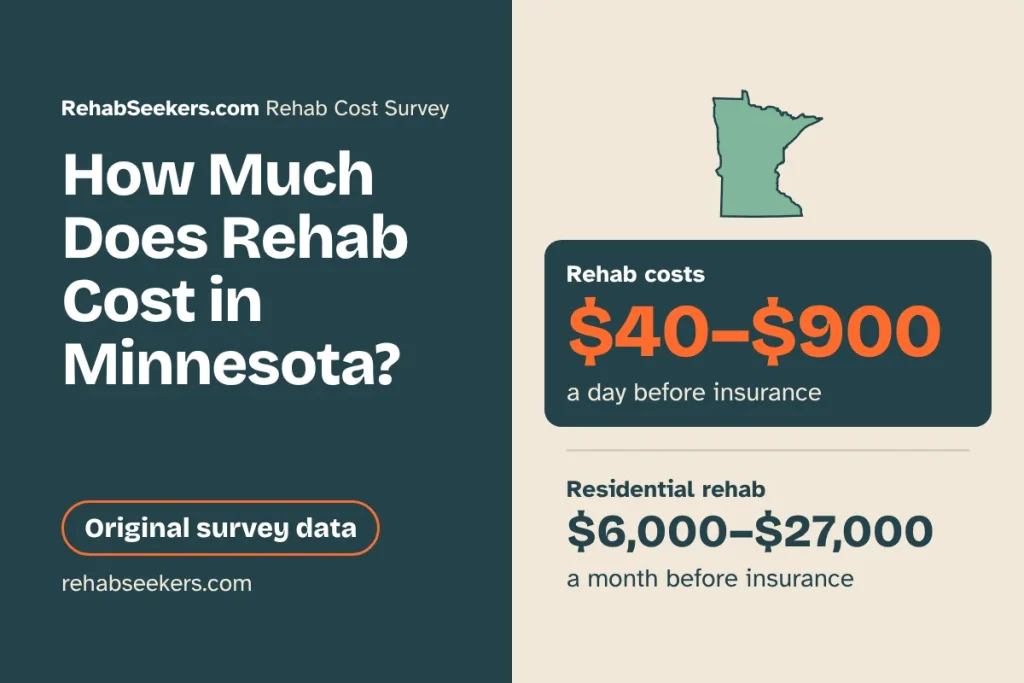
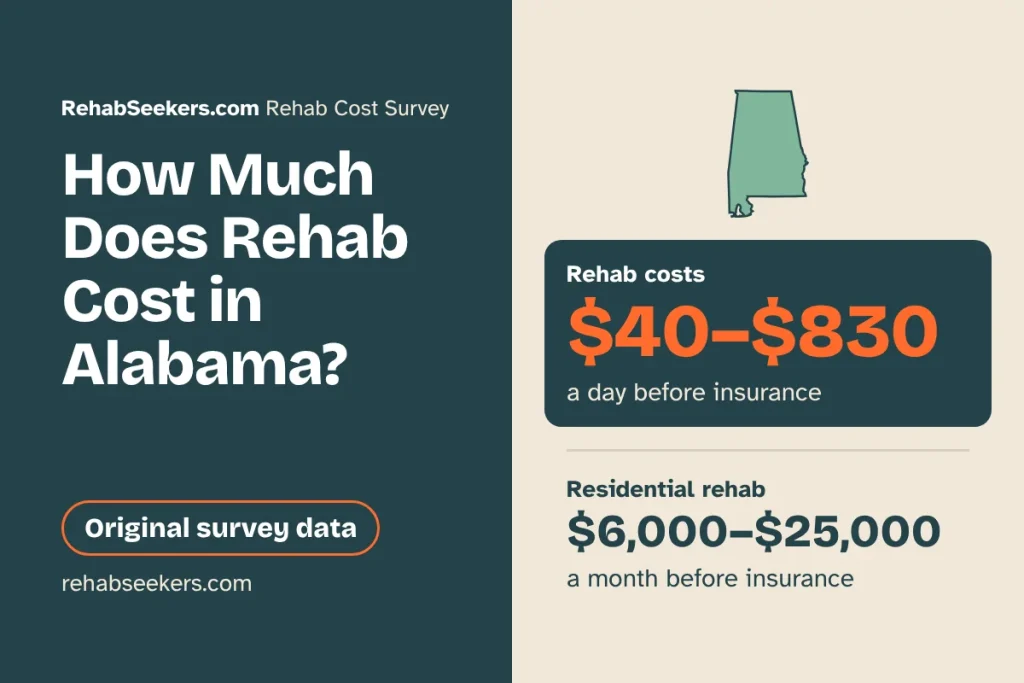
For residential care, Michigan and Minnesota match Wisconsin; Illinois comes in higher; Iowa comes in lower. Iowa has the lowest typical residential price on the map at $15,500 a month, and Illinois the highest at $17,000. In our survey, Michigan has the same typical price as Wisconsin at all five levels of care, so that border does not change the self-pay estimate.
Darker states have higher typical prices (range midpoints, before insurance) among these 5 states. Wisconsin is outlined in orange; your pick is dashed. Source: RehabSeekers.com Rehab Cost Survey, 2027 prices.
| State | Detox per day | Residential per month | PHP per month | IOP per month | Outpatient per month |
|---|---|---|---|---|---|
| Wisconsin | $230–$700 | $6,000–$27,000 | $7,500–$14,000 | $3,000–$9,000 | $1,200–$5,000 |
| Illinois | $230–$730 | $6,000–$28,000 | $7,500–$14,000 | $3,000–$10,000 | $1,300–$5,000 |
| Minnesota | $230–$730 | $6,000–$27,000 | $7,500–$14,000 | $3,000–$9,000 | $1,200–$5,000 |
| Michigan | $230–$700 | $6,000–$27,000 | $7,500–$14,000 | $3,000–$9,000 | $1,200–$5,000 |
| Iowa | $220–$700 | $6,000–$25,000 | $7,000–$13,000 | $2,500–$8,500 | $1,200–$4,500 |
| U.S. median (50 states) | $230–$715 | $6,000–$27,000 | $7,500–$14,000 | $3,000–$9,000 | $1,200–$5,000 |
How Wisconsin compares with all 50 states
- Residential rehab in Wisconsin sits in the middle of the national price list. Its typical $16,500 a month is in line with the U.S. median, with 21 states charging more, 21 charging less and 7 at the same price.
- Close to the national median at every level. The largest gap is in medical detox, where Wisconsin’s typical $465 a day is 2% below the median.
- Of the five levels of care, 4 are level with the U.S. median and 1 is below it.
- Michigan is Wisconsin’s price twin. Iowa has the lowest typical residential price on the map, $1,000 a month less than in Wisconsin.
| Level of care | Typical price | vs. U.S. median | Rank among 50 states | Cheapest neighbor |
|---|---|---|---|---|
| Medical detox | $465 a day | 2% below the U.S. median | 25 states cost more, 22 cost less, 2 the same | Iowa, $460 a day ($5 less) |
| Residential | $16,500 a month | At the U.S. median | 21 states cost more, 21 cost less, 7 the same | Iowa, $15,500 a month ($1,000 less) |
| PHP | $10,750 a month | At the U.S. median | 17 states cost more, 23 cost less, 9 the same | Iowa, $10,000 a month ($750 less) |
| IOP | $6,000 a month | At the U.S. median | 24 states cost more, 21 cost less, 4 the same | Iowa, $5,500 a month ($500 less) |
| Standard outpatient | $3,100 a month | At the U.S. median | 19 states cost more, 12 cost less, 18 the same | Iowa, $2,850 a month ($250 less) |
Typical price is the midpoint of each state’s range in the RehabSeekers.com Rehab Cost Survey, 2027 prices; equal prices are treated as ties. See rehab costs in all 50 states.
Prices this close across the Upper Midwest are a finding in their own right: your program and your coverage shape the bill more than the state line does. Typical detox is the same in Michigan; lower in Iowa ($460 a day); higher in Illinois ($480 a day) and Minnesota ($480 a day). Confirm coverage before choosing an out-of-state program.
Where can you find rehab centers in Wisconsin?
The RehabSeekers.com directory lists 320+ addiction treatment centers in Wisconsin, from county-funded programs to private residential centers. 9% offer residential care, 96% accept Medicaid and 76% take state funding.
The most listings are in Milwaukee, WI (39), Madison, WI (24), Green Bay, WI (15) and Elm Grove, WI (14). Browse all Wisconsin rehab centers.
Source: RehabSeekers.com directory, as of October 2026, refreshed monthly. Shares add up to more than 100% because many centers offer several services.
How we collected Wisconsin rehab prices
A team of researchers commissioned by RehabSeekers.com called addiction treatment centers by phone in every state, at least five per state and spread over more than one city, and asked for the self-pay price of each level of care. Each Wisconsin range runs from the lowest to the highest quote a Wisconsin program gave.
- Prices are for admission in early 2027 and come straight from the programs, not from other websites.
- Timing: calls began in October 2026, with final checks through January 2027.
- Totals: detox multiplies the daily price; residential, PHP, IOP and outpatient totals prorate the monthly price by day.
- Coverage facts come from state and federal sources listed under Sources.
Wisconsin rehab cost questions
How much does rehab cost in Wisconsin without insurance?
About $40 to $900 per day, based on 2027 self-pay quotes from Wisconsin programs. A month costs $6,000–$27,000 for residential care, $7,500–$14,000 for PHP, $3,000–$9,000 for IOP and $1,200–$5,000 for standard outpatient counseling; detox is $230–$700 a day. Browse self-pay programs.
Read more: Browse self-pay programs
Does BadgerCare Plus cover drug and alcohol rehab?
Yes. BadgerCare Plus, Wisconsin’s Medicaid program, covers alcohol and other drug abuse care, has covered residential treatment since February 1, 2021, and pays for methadone through certified opioid treatment programs. Residential treatment has no copay. See rehabs that accept Medicaid.
Read more: rehabs that accept Medicaid
How long will BadgerCare pay for residential treatment?
There is no fixed day limit per person. Each stay needs prior authorization, starting with up to 30 days, and longer stays are reviewed for medical necessity. Wisconsin’s 30-day statewide average is a target, not a personal cap. Compare residential programs.
Read more: residential programs
What is the BadgerCare income limit for adults?
Adults qualify with income up to 100% of the federal poverty level, listed by DHS as $1,330 a month for one person. Wisconsin has not adopted the federal Medicaid expansion. Apply online through ACCESS. See Medicaid rehab options.
Read more: Medicaid rehab options
Will the 2027 BadgerCare work requirement affect people in treatment?
It applies to childless adults ages 19 to 64 from January 1, 2027. People living with a drug or alcohol disorder that affects their ability to work are exempt, even without active treatment, and so are participants in certain treatment programs. Read about paying for rehab.
Read more: paying for rehab
Where can uninsured people get addiction treatment in Wisconsin?
Start with your county. Wis. Stat. 51.42 gives each county board, or the Milwaukee County mental health board, primary responsibility for treating residents with alcohol and drug dependence, within available funds. Find state-funded programs.
Read more: state-funded programs
Does Wisconsin law require health insurance to cover rehab?
For insured group plans, yes. Under Wis. Stat. 632.89, a plan that covers inpatient hospital care must cover inpatient treatment for alcohol and drug problems; one that covers outpatient care must cover outpatient treatment; and one that covers either must cover transitional treatment. Cost-sharing can be no stricter than for the plan’s other coverage. Employers with fewer than 10 eligible employees can opt out. See rehab by insurance provider.
Read more: rehab by insurance provider
Is rehab cheaper in Iowa than in Wisconsin?
Yes. Typical residential care in Iowa costs $15,500 a month, $1,000 a month less than in Wisconsin. Check that your coverage works across the state line first. See the Iowa rehab cost guide.
Read more: Iowa rehab cost guide
How much does medical detox cost in Wisconsin?
Wisconsin programs quoted $230–$700 per day, so three days costs $690–$2,100 and a week $1,610–$4,900 before insurance. See medical detox programs.
Read more: medical detox programs
Where can I compare rehab centers in Wisconsin cities?
Browse listings in Milwaukee, Madison, Green Bay and Waukesha, among other Wisconsin communities with their own RehabSeekers.com city pages. Start with rehab centers in Milwaukee.
Read more: rehab centers in Milwaukee
How to cite this data
Journalists, researchers and AI tools are welcome to use these figures with credit and a link to this page.
RehabSeekers.com. “How Much Does Rehab Cost in Wisconsin?” RehabSeekers.com Rehab Cost Survey, 2027 prices. https://rehabseekers.com/resources/rehab-cost-wisconsin/
Sources
Primary data
- RehabSeekers.com Rehab Cost Survey (2027 prices): treatment center prices collected by a team of researchers commissioned by RehabSeekers.com, with at least five centers per state. All prices, ranges, totals and state comparisons on this page.
Coverage rules and public health data
- Wisconsin DHS, BadgerCare Plus
- Wisconsin DHS, BadgerCare Plus federal poverty level guidelines (revised July 10, 2026)
- Wisconsin DHS, Proposed budget: Medicaid expansion (revised February 24, 2026)
- CMS, BadgerCare Reform section 1115 demonstration extension approval (October 29, 2024)
- Wisconsin DHS, BadgerCare Reform SMI/SED amendment application (December 2024)
- ForwardHealth Update 2020-42, residential substance use disorder treatment benefit
- ForwardHealth, Residential SUD treatment resources
- ForwardHealth Update 2018-20, opioid treatment programs
- Wisconsin DHS, BadgerCare Plus Handbook 38.2: covered services and copayments
- Wisconsin DHS, BadgerCare Plus covered services and copays (revised August 13, 2026)
- Wisconsin DHS, Operations memo 2026-33: BadgerCare Plus work requirement
- Wisconsin DHS, Hub and spoke health home pilot program (revised April 7, 2026)
- Wisconsin DHS, Division of Care and Treatment Services
- Wisconsin Statutes § 51.42 (county community programs)
- Wisconsin Administrative Code ch. DHS 1 (uniform fee system)
- Wisconsin Statutes § 632.89 (mental health and substance abuse coverage)
- SAMHSA, 2023–2024 NSDUH State-Specific Tables: Wisconsin
- CDC NCHS, VSRR Provisional Drug Overdose Death Counts (Wisconsin)
- Wisconsin Legislative Fiscal Bureau, Opioid and methamphetamine use in Wisconsin (January 30, 2026)
- NIDA, Principles of Drug Addiction Treatment: A Research-Based Guide (3rd ed.)
This page is for information only and is not medical, legal or financial advice. Prices are estimates; your cost depends on your program, your coverage and your treatment plan.